CELPIP Reading Practice Test
Master CELPIP reading with comprehensive practice tests and reading comprehension strategies. Perfect your reading skills for Canadian immigration success.
About the CELPIP Reading Test
The CELPIP Reading Test is a vital part of the Canadian English Language Proficiency Index Program (CELPIP) and a key requirement for Canadian immigration, permanent residency, and citizenship applications. This test evaluates your ability to understand and interpret written English used in real-life Canadian contexts.
The reading section measures essential skills such as identifying main ideas, understanding key details, and interpreting information from emails, articles, diagrams, and opinion-based texts. With focused CELPIP Reading practice, test takers can improve reading comprehension, increase reading speed, and work confidently toward achieving CLB 7+ or CLB 9+ scores.
Whether your goal is to meet CELPIP language requirements for immigration or to achieve a high CELPIP score, structured preparation makes a real difference. Practicing with realistic CELPIP Reading mock tests, exam-style questions, and clear answer explanations helps you build strong skills, boost confidence, and perform successfully on test day.
Duration
60 minutes total
Number of Parts
4 distinct reading tasks
Question Types
Complete the sentence, Select the correct inference,
Identify the main idea or purpose, Interpret tone or attitude,
Vocabulary in context, Compare viewpoints or opinions,
Locate specific information
Skills Assessed
Pro Tip for Success
To maximize your CELPIP reading score, practice active reading strategies: skim for main ideas first, scan for specific keywords, and carefully read all instructions before answering. Use official CELPIP reading practice tests regularly to build familiarity with the format and improve your time management.
Reading Specific Preparation Strategies
Understand the Test Format
Familiarize yourself with the structure of each test section (Listening, Reading, Writing, and Speaking). Knowing what to expect will help you manage your time effectively during the test.
Reading Section
Skim through the passage first to get the gist, then read it carefully to answer the questions. Develop effective scanning techniques.
Reading Scoring
Objective Scoring
The Reading sections are scored automatically by the computer. Your score is based on the number of correct answers, which are then converted into the CELPIP scale.
Item Difficulty
The test includes a mix of easy, medium, and hard questions, and your score reflects the difficulty level of the questions you answered correctly.
Score Reference Charts
Reading Score Chart
| CELPIP Level | Reading Score / 38 |
|---|---|
| 10–12 | 33–38 |
| 9 | 31–33 |
| 8 | 28–31 |
| 7 | 24–28 |
| 6 | 19–25 |
| 5 | 15–20 |
| 4 | 10–16 |
| 3 | 8–11 |
| M | 0–7 |
Disclaimer
This example chart shows how scores in the Listening Test and Reading Test approximately correspond to CELPIP Levels. Since questions may have different levels of difficulty and may therefore be equated differently, the raw score required for a certain level may vary slightly from one test to another.
 Task 1
In this part, you will read two pieces of correspondence, typically in the form of letters or emails, and answer 11 multiple-choice questions. The first letter will contain general topics, such as a holiday or family event, and you’ll need to answer six questions based on it. The second letter is a response to the first one, followed by five questions.
11 (6 for the first letter, 5 for the response)
Skim the letters, find key points, and look for paraphrased information.
 Task 2
In this task, you’ll see a diagram or graphic along with an email that responds to it. You need to refer to the diagram to fill in blanks in the email and answer multiple-choice questions. This task tests your ability to understand connections between visual data and written text.
8 (5 fill-in-the-blanks, 3 multiple choice)
Analyze the diagram, relate it to the email, and use the dropdown options to fill in the blanks.
 Task 3
Here, you will read an informational text divided into four paragraphs. Your task is to match nine statements with the correct paragraphs. Some statements may not be supported by any paragraph, so the option 'Not Given' is also available. This task assesses your ability to extract specific information and understand the main ideas.
9 (matching statements to paragraphs)
Skim paragraphs for main topics, scan for keywords, and identify paraphrased information.
 Task 4
This section involves reading an opinion article from a website, followed by a reader’s comment on the article. You’ll answer five multiple-choice questions about the article, and then five questions based on the reader’s comment, where you will fill in the blanks with the best possible options. This task evaluates your ability to understand different perspectives and distinguish between fact and opinion.
10 (5 for the article, 5 for the comment)
Identify different viewpoints, skim for key ideas and names, and recognize paraphrased information.
Task 1 – Reading Correspondence
Read the following message
I’m writing about the pilot schedule posted yesterday at the Granville Public Library. According to the poster, from October 7 to November 30, all weekday closing times will move from 9:00 p.m. to 7:00 p.m., and study rooms after 5:00 p.m. will require a $6 per hour reservation fee, paid online. I understand the need to manage costs and staffing, and I appreciate that this is a trial. However, I’m concerned that the combination of earlier closing and a new evening fee may unintentionally exclude the very people who rely on the library most after work and school.
Here’s why. I’m a project coordinator who commutes from Surrey to downtown Vancouver. Three evenings a week, I meet my younger sister Nisha at Granville to prepare for her CELPIP test. We usually arrive by 6:10 p.m. after her shift ends. With a 7:00 p.m. closing, we’d need to pack up by 6:45 p.m.—barely thirty minutes of real study time once we settle in. Paying $6 per hour for a study room on top of transit and test fees may not sound like much, but for many learners, it’s the deciding factor between staying and leaving. If we go to a café, we end up paying more than that in coffees, and the noise defeats the purpose. Is that truly the outcome we want for a public learning space?
I also volunteer on Saturdays for the Homework Club, and I’ve noticed that the busiest period for quiet study is between 6:00 p.m. and 8:30 p.m. during midterms and language-test seasons. Several international students told me they don’t have stable internet or a quiet desk at home. An online-only payment system for rooms at 5:45 p.m. locks out anyone with a slow phone or a declined card—even when rooms are empty.
I’m not criticizing the need to experiment; I’m asking that the pilot measure the right outcomes. Could the branch keep two late evenings (e.g., Tue/Thu) until 9:30 p.m.? Or waive the evening room fee for students who show an upcoming exam date? Even a 15-minute grace period at closing would prevent the rush that sends people into the street mid-paragraph. I’m happy to volunteer on one late night to help with room checkouts if staffing is the issue.
Thank you for considering adjustments that keep the library affordable and welcoming, especially for learners who study after work. I’d appreciate a reply so I can plan Nisha’s schedule this month.
Sincerely,
Arjun Mehta
Library Member #482917
Choose the best option according to the information given in the message:
1. What is the main purpose of Arjun’s message?
2. During the pilot, what change is proposed for weekday closing times?
3. Why does Arjun believe the evening study-room fee could be a barrier?
4. What is implied about the busiest time for quiet study?
5. In the sentence “Is that truly the outcome we want for a public learning space?”, “that” most likely refers to …
6. Which suggestion does Arjun NOT make?
Here is a response to the message. Complete the response by filling in the blanks. Select the best choice for each blank from the drop-down
Task 2 – Reading to Apply a Diagram
Reference Image
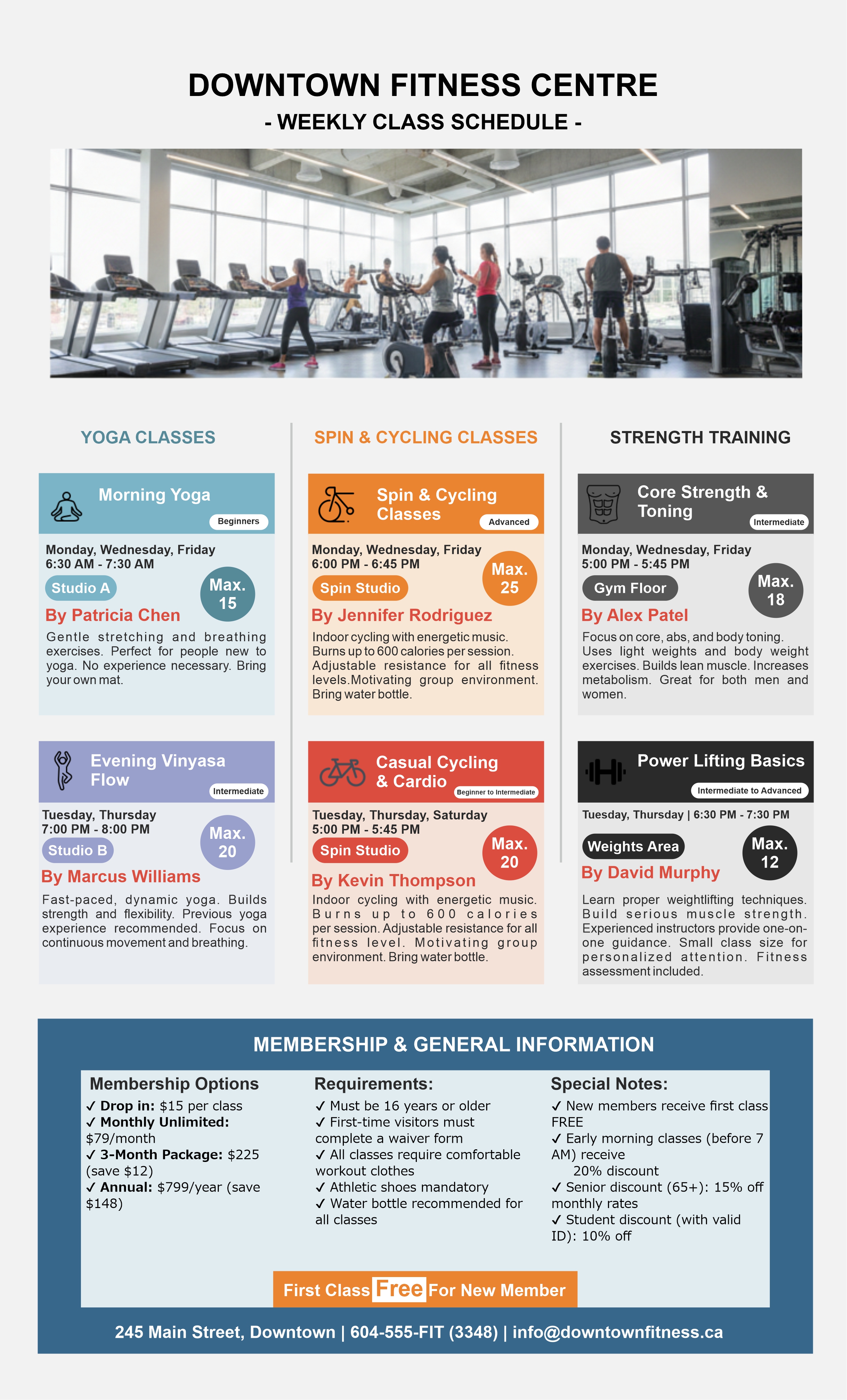
Read the following email message about the diagram on the left. Complete the email by filling in the blanks. Select the best choice for each blank
I hope you're doing well! I know you mentioned wanting to get back into fitness, and I found something that might interest you. I joined the Downtown Fitness Centre last month, and they have a great variety of 12.....
Since you're completely new to exercising, I really think 13.... would be perfect for you. It's beginner-friendly and doesn't require any experience. I go to those classes on Monday, Wednesday, and Friday mornings at 6:30 AM.
However, if you're looking for something more intense and want to build muscle quickly, there's also 14..... It's more challenging, but it has a small class size so you get personalized attention.
One thing I should mention is that the centre requires everyone to bring 15..... It's important to stay hydrated, especially during the harder classes.
Also, if you're interested in cycling, they have two options. The 16.... is fast-paced and burns a lot of calories, while the casual cycling class is more relaxed. Both are pretty popular!
All new members get their first class free completely free! So you could try a class before you decide to buy a membership. Membership is only $79 a month for unlimited classes, which I think is a great deal.
Let me know what you think, and maybe I'll see you at one of the classes!
Best,
Lisa
Choose the best option:
17 What is the purpose of Lisa's email?
18 What can we infer about Lisa?
19 When Lisa says 'Membership is only $79 a month for unlimited classes, which I think is a great deal,' what does she mean?
Task 3 – Reading for Information
Read the following passage.
Prior to the 1830s, long-distance communication was inextricably linked to physical transportation; a message could move no faster than a horse or ship. The commercialization of electromagnetic telegraphy shattered this constraint. While early prototypes used cumbersome needle indicators, Samuel Morse and Alfred Vail revolutionized the field by assigning a binary code of short and long pulses to letters. This system superseded rival technologies because it allowed complex human language to be encoded into simple electrical states. By transmitting data through copper wires, they effectively created the ancestor of modern digital data transmission, marking the first time information was decoupled from physical dispatch.
The network expanded with aggressive speed, fundamentally altering global economics. By 1861, a transcontinental line linked the U.S. coasts, rendering the Pony Express obsolete overnight. The 1866 completion of a durable transatlantic cable reduced message transit time between London and New York from twelve days to mere minutes. Although early tariffs were prohibitive—often costing the equivalent of a skilled laborer's daily wage for ten words—the utility for governance and commerce was unmatched. Commodity traders in Chicago could synchronize prices with New York in real-time, creating the first true global markets, while governments used the network to centralize administrative control over vast territories.
Despite its transformative power, the infrastructure was fragile and financially demanding. Submarine cables were frequently severed by fishing trawlers or marine seismic activity, necessitating expensive and dangerous repair expeditions. Furthermore, the system suffered from low bandwidth; even skilled operators were limited to transmitting 20 to 40 words per minute. As commercial volume surged, this bottleneck spurred research into 'harmonic telegraphy'—sending multiple tones on a single wire to increase capacity. It was this specific pursuit of higher telegraph efficiency that inadvertently led Alexander Graham Bell to patent the telephone in 1876, initially seen merely as an improvement on telegraphy.
The telegraph's influence persists in the architecture of the information age. It forced humanity to rethink the concepts of time and space, creating a psychological 'global village' long before the internet. The abbreviated, function-focused language of telegrams anticipates the text-speak and character limits of 21st-century social media. Moreover, the global cable network established in the Victorian era laid the physical routes for the fiber-optic internet cables of today. Although the hardware is obsolete, the protocol of breaking information into discrete electronic signals remains the foundational logic of all modern computing.
Decide which paragraph, A to D, has the information given in each statement below. Select E if the information is not given in any of the paragraphs.
Task 4 – Reading for Viewpoints
Read the following article from a website.
Stephanie Lee is a science teacher at Ryerson Secondary who believes that real science should encourage critical thinking, even if it means challenging what's written in the textbook. Part of the curriculum involves learning about climate change, and Lee was dismayed to find the textbook material to be "little more than propaganda, which claims that global warming is chiefly a human-caused phenomenon." Lee argues that education is supposed to teach students how to see objectively, yet textbooks often monopolize certain viewpoints and push them as the only truth. In the case of climate change, Lee was appalled to find that no alternative theories were presented.
Lee taught her students additional perspectives. Not only did she teach the theory of anthropogenic global warming, that is, that global warming is caused by human consumption of fossil fuels and the release of carbon dioxide into the atmosphere, but also taught that throughout history, the earth's temperature has naturally risen and fallen.
Other science teachers at Lee's school have raised concerns that Lee's approach is only confusing students. Carol Harvey argues that the greenhouse gas effect and subsequent global warming is not a controversy in the scientific community. It has been proven that humans have increased the amount of greenhouse gases in the atmosphere by roughly 30% in the last 100 years. "Our textbooks are up to date, and Lee is only prompting students to dismiss valuable textbook information," Harvey says.
Lee disagrees, asserting that science should not shy away from evaluating multiple perspectives. "Carbon dioxide changes have not been proven to be the primary cause of global warming," Lee says. "In fact, research indicates the reverse might be happening: global warming might be causing changes in carbon dioxide levels. Either way, my job is to help students to analyze both theories, not simply accept the one presented in the textbook."